
Choosing the right off-road shock absorber is one of the most important decisions when upgrading a 4×4 suspension system. Shock diameter, vehicle weight, lift height, driving conditions, and suspension configuration all influence how a shock performs.
For many 4×4 owners, the most common question is simple: Should I choose a 2.0-inch or 2.5-inch off-road shock?
HPR Offroad Shocks offers both 2.0-inch off-road shocks and larger 2.5-inch mono-tube and remote-reservoir shock configurations for different vehicle applications. The correct choice depends on how the vehicle is used rather than simply choosing the largest shock available.
What Does Shock Diameter Mean?
Shock diameter generally refers to the outside diameter of the main shock body.
A larger shock body can provide greater internal volume and increased capacity for managing heat during demanding suspension operation. This can be particularly useful for heavy vehicles, long-distance overlanding, high-speed off-road driving, and applications where the suspension experiences repeated impacts.
However, bigger does not automatically mean better.
The shock must be correctly matched to the vehicle’s suspension geometry, spring rate, wheel travel, vehicle weight, and intended use.
HPR 2.0 Off-Road Shocks
HPR’s 2.0-inch off-road shock series is designed for a wide range of 4×4 and overland applications.
Current applications include vehicles such as:
- Toyota Land Cruiser 300
- Toyota Land Cruiser 200
- Toyota Land Cruiser Prado 150
- Toyota Land Cruiser Prado 120
- Toyota 4Runner
- Suzuki Jimny
The product range includes applications designed around approximately 2.5 inches of lift depending on the specific vehicle configuration.
A 2.0-inch shock can be an attractive solution when a vehicle needs improved damping performance without moving to a larger racing-oriented shock package.
HPR 2.5 Mono-Tube Shocks
The 2.5-inch mono-tube range is aimed at more demanding off-road applications.
Compared with a smaller shock body, a 2.5-inch mono-tube design can offer increased oil volume and thermal capacity. This can be valuable when a vehicle is carrying additional equipment or is repeatedly driven over rough terrain.
HPR’s product range includes 2.5-inch applications for vehicles such as Toyota Land Cruiser models, Ford F-150, Toyota FJ Cruiser, Toyota Tacoma, Toyota Tundra and other 4×4 platforms.
When Should You Choose 2.0 Shocks?
A 2.0-inch shock can make sense when:
- The vehicle is used primarily for recreational off-roading.
- The vehicle has a moderate suspension lift.
- Weight increases are limited.
- The driver wants improved damping without an oversized shock package.
- Installation space is limited.
- The vehicle is used for both road driving and weekend trails.
For many SUV and compact 4×4 applications, a properly matched 2.0 shock can provide a significant improvement over standard factory dampers.
When Is a 2.5 Shock Better?
A 2.5-inch shock becomes more attractive when the vehicle experiences higher thermal and mechanical demands.
Typical applications include:
- Heavy overland builds
- Long-distance desert driving
- High-speed off-road driving
- Heavily loaded pickup trucks
- Larger suspension lifts
- Repeated suspension cycling
- Vehicles equipped with additional armor and recovery equipment
The goal is not simply to install the largest shock. The goal is to create a suspension system where the shock, spring and vehicle weight work together.
Does a Larger Shock Automatically Improve Ride Quality?
No.
Ride quality depends on the complete damping system.
A large shock with an unsuitable valving setup can perform worse than a smaller shock that is correctly matched to the vehicle.
Important factors include:
- Shock diameter
- Piston design
- Oil volume
- Nitrogen pressure
- Compression damping
- Rebound damping
- Spring rate
- Vehicle weight
- Suspension travel
- Tire size and pressure
This is why vehicle-specific shock development is important.
2.0 vs 2.5: Quick Comparison
| Feature | 2.0 Off-Road Shock | 2.5 Mono-Tube Shock |
| Shock body | 2.0 inch class | 2.5 inch class |
| Typical use | Trail and overland | Heavy-duty and demanding off-road |
| Heat capacity | Moderate | Higher |
| Packaging | Easier | Requires more space |
| Vehicle weight | Light to medium | Medium to heavy |
| High-speed use | Application dependent | Better suited to demanding applications |
| Upgrade potential | Excellent | Excellent for advanced builds |
What About Remote Reservoir Shocks?
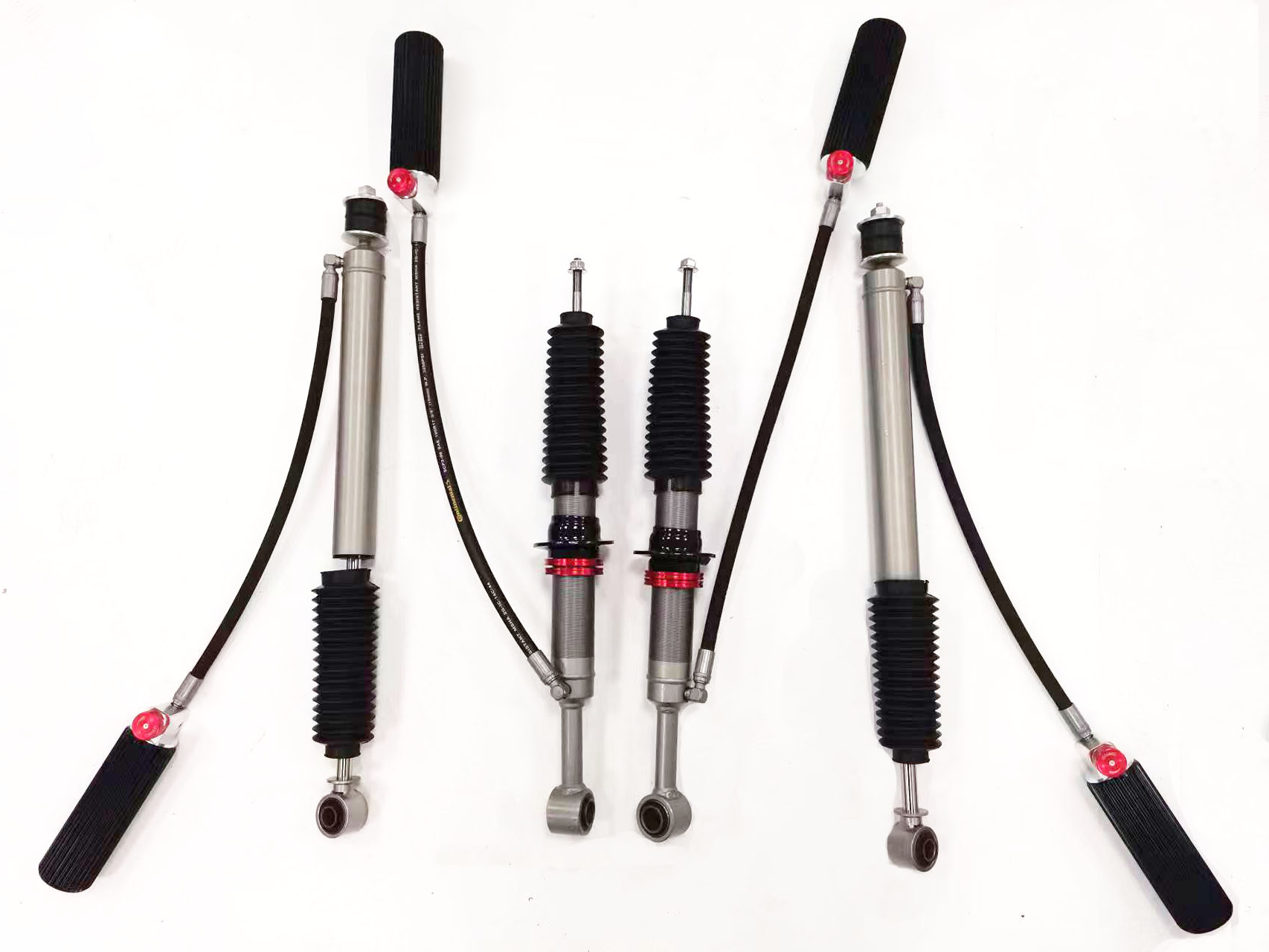
A remote reservoir provides additional gas and fluid volume outside the main shock body.
This configuration can improve thermal management and allow greater flexibility in shock packaging.
HPR’s Double Hose Offroad Shox range uses remote-reservoir configurations with compression and rebound adjustment for a number of demanding 4×4 applications.
Final Recommendation
If your vehicle is a relatively light 4×4 used for trail driving and overlanding, a properly matched 2.0-inch shock may be sufficient.
If your vehicle is heavier, carries significant equipment, travels at higher speeds off-road, or experiences repeated suspension impacts, a 2.5-inch mono-tube or remote-reservoir configuration may be a better solution.
The most important factor is not simply 2.0 vs 2.5. It is selecting a shock specifically matched to your vehicle, lift height, weight and driving conditions.
Need Help Choosing the Right Off-Road Shocks?
HPR Offroad Shocks supplies vehicle-specific off-road shock absorbers for 4×4, overland and racing applications.
Visit HPR Offroad Shocks to check available applications and contact the factory for product recommendations:
Contact: +86 136 1658 6065
Service Hours: 9:00–23:00 dail
Post time: Sep-21-2026